|
ORIGIN OF THE McKAIN FAMILY |
"The Macdonalds of Ardnamurchan. This family was descended from John (Iain) Sprangach, third son of Angus Mor, Lord of the Isles. The genealogical details obtainable regarding this family are very meagre, owing to their disappearance as a territorial house upwards of 250 years ago. They were known as Macians, owing to their descent from John, son of Angus Mor." - "The Clan Donald" by Rev. A.Macdonald (Minister of Killearnan) and Rev. A.Macdonald (Minister of Kiltarlity), published 1904.
The succession was as follows:- Note: dates are those of clan chiefship
1st John (Iain) Sprangach (1260- after 1306), son of Angus Mor, son of Donald, progenitor of the clan
2nd Angus (after 1306-1363), son of John Sprangach
3rd Alexander (1363-c1411), son of Angus
4th John (c1411-1470), son of Alexander
5th Alexander (1470-c1490), son of John
6th John 'Brayach' (c1490-1518), nephew of Alexander
7th Alexander (1518-bef.1538), son of John 'Brayach'. Note: according to Donald J. Macdonald in "Clan Donald (1978)", Alexander "was a mere child on his accession and appears to have died before reaching his majority."
8th Alexander (c1538-c1570), grandson of John 'Brayach'
9th John, (c1570-c1591), son of Alexander
10th John Og (c1591-1596), son of John
11th Donald (1596-1596), uncle of John Og
12th John Macian (1596-c1609), nephew of Donald
13th Alexander (c1609-1625), son of John Macian
"Alexander is the last head of the house of whom there is any authentic record and with him this ancient and powerful house passes out of historical and genealogical ken". - "The Clan Donald" by Rev. A.Macdonald (Minister of Killearnan) and Rev. A.Macdonald (Minister of Kiltarlity), published 1904. Not according to Clifford Arthur Mackain ! - see below
"It appears that Alexander MacIain , the head of the family, received a considerable sum of money in name of compensation for his claims on the lands of Ardnamurchan. At Edinburgh, on 22nd April 1629, he gave his bond for £40,000 Scots to Robert Innes, burgess of Fortrose, a sum which represented at that time a very large fortune. It would appear from this transaction that however much the family of Ardnamurchan may have suffered otherwise, they were now, financially at least, in a very flourishing condition." - "Clan Donald" by Donald J. Macdonald of Castleton 1978.
Many of the members of the MacIan sept were driven out of Ardnamurchan in the first part of the 17th century and being staunchly Roman Catholic, even after the Reformation of 1560-67 in Scotland, they made for the east of Scotland and the areas of Moray and Banff, including the parishes of Boharm, Rothes and Knockando, amongst others. There are indications that by the 18th century several members of the McIan or the Mckain families had become merchants in Elgin, although none of them appear on the only partially complete Burgess Roll which appears as an Appendix to the "Records of Elgin". This lack of appearance on the Burgess Roll may be the result of either its incompleteness or the McKains' retention of the Catholic faith, which may have prevented them from formally becoming Burgesses of the town". (with acknowledgement to Janet & Bruce Bishop and the efforts of my cousin Hannah Davies)
Robert Young noted in 1879 ("The Annals of the parish and burgh of Elgin") "The Mackeans were long merchants aand traders in Elgin and acquired a good deal of burgh property. They intermarried with the Donaldsons of Kinnairdie and other respectable families in the town". Young also noted that the Mackeans carried on a tanning trade in premises where the "present shambles now stands" but the family "died out early in this century" (19th).
Extract from the "History and Genealogy of the Ancient House of Ardnamurchan" by Clifford Arthur Mackain M.A., F.R.E.S., 1943. (I am indebted to Colonel Alexander Fergus MacKain-Bremner for providing me with full access to this document)
"Alexander (Chief 1610-1625) was a minor at the time of his father's death, and his uncle Donald acted as Tutor. He was forced to give up his right to Ardnamurchan, and in 1625 migrated with his brother John to Inverness-shire. He went next to Morayshire, where his descendants are now to be found in Elgin. He was buried at Ruthven. His descendants became prominent in Elgin, and at one time owned considerable property there and in the neighbourhood. Another branch migrated to Ireland in 1674; while other MacIains are found in Edinburgh from about 1625. These are probably descended from Donald the Tutor."
In his "History...", Clifford Mackain makes a claim for extending the line of clan chiefship from Alexander (1610-1625) to himself, as follows (Note: dates are those of clan chiefship):-
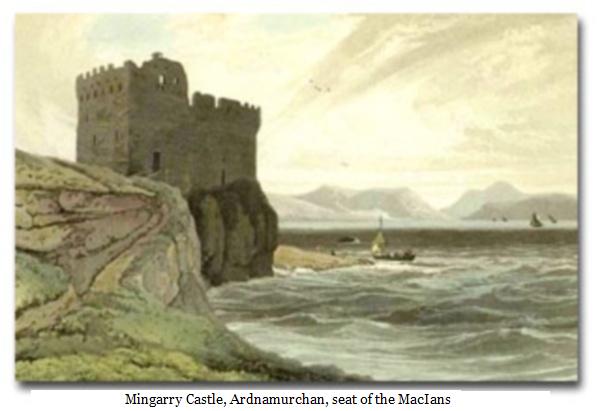
Note:- Although not appearing in Clifford's research, Angus is posited by David Macdonald, in his book "The MacIains of Ardnamurchan", as possibly the eldest son of Alexander the 13th Chief of MacIain of Ardnamurchan and, after Alexander's death, the Representative of the family. The basis for this is the mention of "Angus McKeane of Ardemurchan" in the Mackay Papers ( National Records of Scotland) dated the 28th July 1662, "setting forth his claim to the lands of Ardemurchan and Swinehard (Sunart) with his castle of McGary (Mingary) of which he has been dispossessed by Argyle." It does not appear that Angus left any issue and was succeeded in the representation of the family by his brother Alexander.
Alexander (????-1719), son of Alexander (1610-1625)
James (????-1737), son of Alexander
Archibald (1737-1777), son of James
James (1777-1828), son of Archibald
James (1828-1845), son of James
James (1845-1847, died unmarried), son of James
William Fergus (1847-1912), brother of James
Rev. William James (1912-1936), son of William Fergus
Clifford Arthur (1936-1959), son of William James
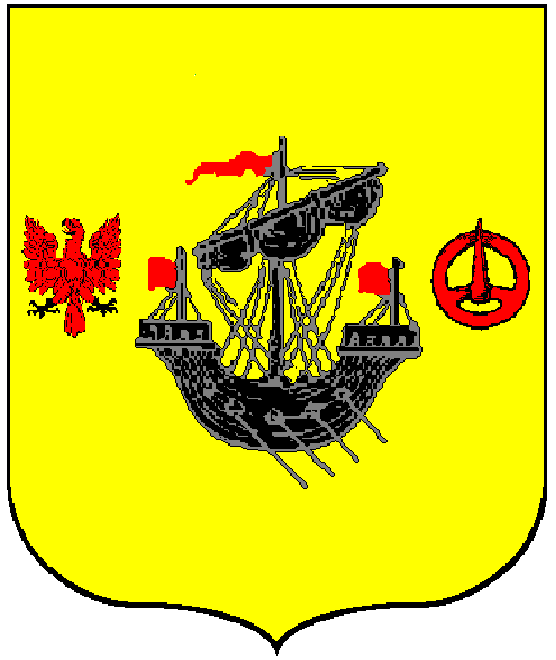
The association of the McKains with the Western highland seabord is reflected in the Grant of Arms to the Reverend William James McKain in 1905, viz:- Or, a lymphad, sails furled, oars in action Sable, flagged Gules, an eagle displayed of the Last, beaked and membered of the second and a buckle of the third, in the dexter and sinister fess points. In 1913 William James was recognised by the Society of Clan Donald as Chief of Clan Iain of Ardnamurchan.
IN HOPE I BYDE
"The lymphad or heraldic galley is a charge very common in Scotland, particularly among the clans of the Western highland seaboard. It was an ancient one-masted oar-propelled ship, usually shown as flagged at both ends and at the topmast. The earldom of Arran has as its arms Argent a lymphad with sails furled proper, flagged Gules. The 3rd quarter of MacKinnon of MacKinnon is Or a lymphad, sails furled, the oars saltirewise Sable, flags flying Gules. When the oars are in the water they are sometimes described as oars in action" - (The Observer's Book of Heraldry - Charles Mackinnon of Dunakin)
